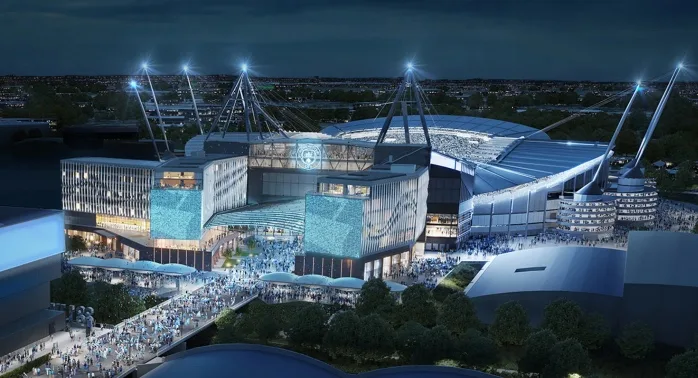
The cranes have been part of the view for a while, but Manchester City's expanded North Stand has moved past the building site phase. It now carries a name that matters.
The club have confirmed the stand will be called the Pep Guardiola Stand. That is not a small detail. It turns a construction project into something with emotional weight, and it arrives at a moment when the club need that weight most.
City's official ticketing guidance says more than 7,000 general admission seats are being added, pushing the Etihad past 60,000 capacity. At least 3,000 of those will be rail seats, with room for more depending on demand. For a fanbase that has taken criticism about atmosphere and scale, those numbers matter.
The practical side
The most significant line in the club's update was not the emotional one. It was the operational one. City invited supporters to a first public event in the new section as part of a phased opening, with both public and private test events designed to check the facility works properly before full use.
A modern stand has to do more than hold people. It has to move them through concourses safely, serve food and drink at volume, protect sightlines, manage rail seating, pass stewarding checks and connect to the wider stadium without disrupting the old bowl's rhythm.
City said the initial public event would run at 50% of the additional seating capacity, allowing more than 3,500 fans to attend, before a proposed 100% capacity trial at the final home game against Aston Villa. That tells you this is being treated as a live matchday system, not a ceremonial ribbon-cutting.
Timing and context
The timing is hard to ignore. Guardiola's managerial spell has closed. Enzo Maresca has signed a three-year contract. The club are trying to make continuity feel bigger than one dugout.
Naming the stand after Guardiola preserves the most successful period in City's history inside the stadium fabric. Opening it properly under Maresca makes it part of the next one.
For Maresca, the football relevance is obvious. New managers usually inherit tactical questions first. At City, he also inherits the pressure of conducting that work inside a stadium being reintroduced to itself.
The expanded North Stand gives City the chance to create a louder end behind one goal. If the rail-seat section works as intended, and if the pricing model keeps the area accessible enough to concentrate regular voices rather than occasional visitors, Maresca's first season could begin with a sharper home advantage than Guardiola left behind.
The ticket test
City's ticketing note for the Pep Guardiola Stand contains the sort of information supporters study more closely than any launch video. The club says 4,000-plus new Flexi Season Tickets will be released across the stadium for 2026/27, with 50% ringfenced for Junior Members.
That is a smart political move, but it also sets a test. Expansion projects often sell themselves on access, only for the completed venue to lean heavily into premium seating and hospitality. City are attempting to do both: increase general admission capacity, open new bar and hospitality spaces, and place the development inside the broader Medlock Square destination.
City's own FAQ says the stands behind the goals should continue to carry the lowest-priced tickets, and that the expanded area will retain an equivalent number of lower-priced seats. That is the line supporters will remember if demand spikes. Once a stand is named after the manager who made City feel almost inevitable, the club cannot afford for it to feel detached from the supporters who lived through the climb.
The bigger picture
The stadium expansion is not just a North Stand story. The club's public material ties it to hospitality areas, the fan zone and the wider Medlock Square development opening later in 2026. That moves the Etihad Campus closer to the year-round destination model now shaping the biggest football venues.
For City, that is strategically important. They do not have the central-city mythology of Maine Road anymore, and they do not have the inherited global stadium identity of Old Trafford, Anfield or the Bernabeu. The Etihad has always had to build its emotional weight at speed. Guardiola supplied the football memories. The campus now has to supply the gravity.
A bigger stadium helps, but the real commercial upside sits around dwell time. If supporters arrive earlier, spend longer around the ground, use new bars, visit hotel and entertainment spaces, and treat the campus as a pre-match and post-match destination, City's matchday revenue ceiling changes.
That matters in football terms because revenue is competitive power. The clubs most able to refresh squads without lurching between cycles are usually the clubs with multiple income engines. A more productive Etihad Campus adds another layer.
Optics around Maresca
It also changes the optics around Maresca. A new manager replacing Guardiola could easily look like the headline act in a comedown season. Instead, City are surrounding him with visible institutional momentum: a renamed stand, added capacity, new ticket products, campus openings and a squad still being reshaped for another title push.
That does not remove pressure. It reframes it. Maresca is not being asked to begin again. He is being asked to make sure the new stadium energy does not expose any loss of authority on the pitch.
There is a risk in naming infrastructure after a living benchmark. It keeps the best years close, but it also makes comparison unavoidable. Every flat home performance, every passive first half, every anxious finish will now unfold in a ground where Guardiola's name is part of the backdrop.
The challenge is to make the tribute feel active. The Pep Guardiola Stand should not become a museum label attached to a more expensive matchday. It has to become the place where the next version of City feels most alive: younger supporters, safe standing, lower-priced seats behind the goal, and enough noise to make the Etihad's old criticism sound badly out of date.